
NJ Teachers of English to Speakers of Other Languages/
NJ Bilingual Educators
From the Editor: Roselyn Rauch, Ed.D.- The Buzz is On
President’s Message: Judie Haynes
NJTESOL/NJBE Spring Conference 2012
Vice-President’s Message: Cassandra Lawrence
Technology at the Spring Conference: Marilyn Pongracz
2012 Spring Writing Scholarship Contests and Adult/Colleague Awards: Call for Applications
Our ELLs Need Your Support: It’s Giving Time Again
Common Core Standards Conference at Kean University (March 22)
Technology: Marilyn Pongracz
Chapter News: Bergen-Passaic Chapter
From The Editor
The Buzz is On
By Roselyn Rauch
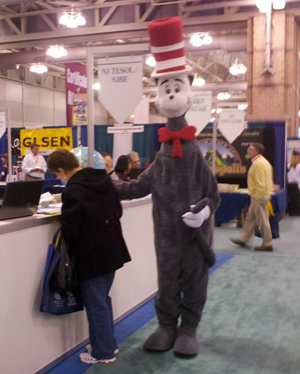
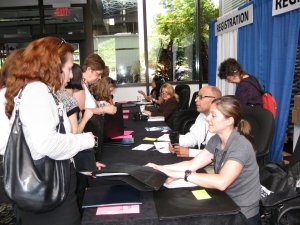
Carmen E. Martinez, Camden District WWHS Bilingual Teacher of Social Studies, is signing up with NJTESOL/NJBE as the Cat in the Hat looks on.
I am writing this from the NJEA 2011 Convention in Atlantic City. And the exhibitors’/vendors’ hall is truly buzzing. Both Thursday and Friday, dedicated professionals/paraprofessionals/support personnel/and teachers-in-training, among many others including visitors, walk the hall floor searching for the latest materials and methodologies to bring back to their classrooms. Of course, the little chotchkes (trinkets) that each exhibitor/vendor treats us with do not go unappreciated.
Our own Anneke Forzani, Judie Haynes, Karen Nemeth, Sandee McBride, and Marilyn Pongracz presented workshops. Judie presented Strategies for Teaching English Language Learners across the Content Areas; Marilyn led a workshop on Websites and Applications for Differentiating Instruction; Sandee and Anneke co-presented Welcome to the Multicultural Classroom; and Working with the Science of First and Second Language Development was addressed by Karen.
Joan Pujol and your editor manned (wo-manned?) the NJTESOL/NJBE booth on the exhibition floor fielding questions about the organization and signing up new members. Your editor also walked the floor speaking with exhibitors/vendors encouraging them to place ads in this publication (please patronize them and tell them where you saw their ad) and also speaking with vendors encouraging them to have a booth at our spring conference in May.
It may seem early to you, but we are searching for workshops for next November’s NJEA Convention. We know that so many of you are keeping your strengths and talents hidden. Don’t. Please share your experiences and wealth of knowledge. If you are hesitant about leading a workshop, speak with those who have, or present with a colleague. You can do it! This is a great opportunity for those of you who can’t get to our May Conference to hear from other ESL/BE educators. The deadline for the 2012 NJEA Convention workshop proposals is March 1.
(continued below)
And now a peek at what is inside this winter 2012 edition of Voices:
We are so looking forward to the Spring Conference at the Hyatt in New Brunswick on May 30 and May 31. Be sure to put in for your professional development days so that they will be approved in a timely fashion. Although the parking was less than stellar last year, we have been working diligently to remedy the situation. Of course, the best bet always is to take public transportation or carpool if you can. All proposals have been adjudicated and the selections are amazing. It is amazing how each year we can actually improve the quality of the conference as a whole. Don’t miss it.
Our president, Judie Haynes, reveals her favorite educational blogs and newsletters. Vice President Cassy Lawrence writes about the upcoming Spring Conference: if you had any doubts about whether or not you wanted to attend, Cassy’s article will certain whet your appetite and sway you to Be There. She provides a comprehensive overview of the conference’s highlights. Be sure to read it and be sure to attend in May.
From the Special Interest Groups:
Monica Schnee reflects on November and December parent-teacher interactions and the latest from WIDA. Karen Nemeth reveals an underused community resource. Tina Kern discusses the placement of twins while Noreen Drucker follows the progression of Bilingual and ESL Education Through the Years, background information every professional should know. Regina Postogna writes about Opportunities and Challenges and reminds us of law that should be imprinted on our professional brains.
Caia Schlessinger gives us Preparing High School ELLs for Post-Secondary Life and information on the $1,500 Pedro J. Rodriguez High School Scholarship and the $1,000 Héctor R. Villafañe Memorial Scholarship.
Claudia Plata writes about Success Across The Curriculum and Aleks, a useful website. Our technology resource and webmaster, Marilyn Pongracz, writes about a website, too, Learning Chocolate. She also gives us Is the Social Media Making Us Stupid? and a glimpse into what technology will be presented at the spring conference in May.
Gail Verdi brings us to vampires and fairies (not a misprint) in Readings: Thinking Globally and Acting Locally about Identity and Education: the connection? You will have to read the article at end to find out…
Be sure to check the Calendar and see what is happening near and far. Locally, our Bergen-Passaic chapter had two great year- beginning meetings: read their reports and see the great turnout in the photos.
As always, I encourage you to read what is happening in all of SIGs. Being well-informed increases our ability to advocate for our students, and that is what we are all about.
Keep the buzz going and enjoy this issue.
Roselyn
Roselyn Rauch, Ed.D., is the editor of Voices and a retired ESL/ESL Resource teacher from the Paterson Public School System. She is a consultant with ESL Unlimited.
President’s Message
By Judie Haynes
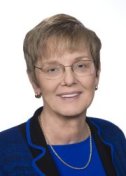
Every day I read online educational blogs and newsletters. Of course I am interested in articles about ESL/bilingual issues but I do read extensively in the field of general education because I believe many of these issues will affect our students. A few colleagues have asked me to share what I read. The following are a few examples
One of my favorite people is Corey Heller and her Multilingual Living Magazine. In December’s issue, Multilingual Living features Dr. Fred Genesee’s article, 5 Concerns About Children Becoming Bilingual. In this article, Dr. Genesee discusses how children become bilingual and what this means for their language development. Because many elementary school educators, parents and early childhood specialists lack information about bilingualism, they view childhood bilingualism as a negative. According to Dr. Genesee, this is especially true in school districts where most of the students are monolingual. Our job as ESL and bilingual educators is to inform our colleagues and administrators of the latest research on bilingualism in young children. We do not want our schools to teach students English to the detriment of their first language.
During the last week of December, eSchool News, a technology online blog, features the 10 Top Stories in Education for 2011. One of the articles on this list that caught my attention, Five characteristics of an effective 21st-century educator, gives us the results of a survey eSchool conducted among their readers. High on the list is the quality of being a life-long learner. Although their attributes involve technology, I think their definition is important in all areas of teaching: An effective 21st-century educator is a flexible, life-long learner, willing to accept and embrace change, willing to make a mistake and be wrong. This is definitely something we want to teach our students. Before we can teach this, we need to do it ourselves.
Another online publication that I read regularly is Scoop_it. which is curated by James Lerman. I love the layout of this publication, which consists of a page of top stories with their pictures and a short paragraph. If you click on one of the titles, you get the full article. One of my favorite recent issues is on creativity. Scroll down to the issue to Twelve Things You Were Not Taught in School about Creative Thinking. Because teachers of ELLs are currently being pushed to help students improve their standardized test scores, creativity can be lost in our classrooms. This issue of Scoop it reminds us of its importance.
Teachers College Record recently featured an article on Assessing English Language Learners’ Opportunity to Learn Mathematics. I was amazed to see that there was a study to tell us that ELLs had a lower level of Opportunity to Learn (OTL) than non-ELLs. The conclusion of this study is that this difference in OTL in ELLs contributes to the performance gap between ELLs and non-ELLs. I’m happy that the research is catching up with what we in the field of bilingual and ESL education have known for nearly thirty years.
I’d like to wish NJTESOL-NJBE members a Happy New Year 2012!
Coming Soon!
NJTESOL/NJBE Spring Conference 2012: Wednesday—Thursday May 30th & 31st, The Hyatt Hotel, New Brunswick:
See the Vice-President’s Message for a comprehensive overview of THIS year’s event.
Vice-President’s Message
Looking Forward to the 2012 Spring Conference
By Cassandra Lawrence
How do we engage our youngest language learners? What can we do to make curriculum accessible for elementary and middle grade students? How do we motivate students at the high school level? What do we focus on the most as ESL and bilingual teachers? What, as mainstream teachers, do we need to know? What about language? And content? How do we bring it all together?
This year’s conference theme – Success for ELLs Across the Curriculum – reflects the hard work, expectations, and aspirations of ELL practitioners and their students. While we’re dutifully concerned with the transition to the Common Core State Standards, we’re also charged with meeting language objectives – often within time and program constraints. Our goal for this Spring Conference is to support you in meeting these challenges. I am confident your conference experience will provide you useful insights and tools to help you and your students.
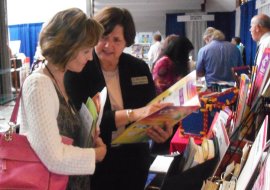
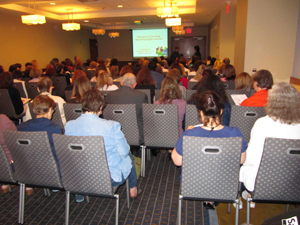
Both days of the conference will open with a morning general meeting and keynote presentation. You’ll get to meet the organization’s leaders, as well as join in acknowledging our scholarship and award recipients. After the morning keynote sessions, we’ll have a great variety of workshops to choose from, as well as poster sessions, exhibitors, and networking opportunities. Here are just some of the conference highlights we’re looking forward to.
We will hear from Keynote speakers Maria Dove and Andrea Honigsfeld on Day One of the conference. Their keynote presentation, Common Core Collaborations, will help us to develop an understanding of how to best meet the Common Core State Standards with English Language Learners in mind, along with supportive instructional and non-instructional collaborative practices. As a follow-up to their keynote, Dove and Honigsfeld will present an afternoon session titled Co-Teaching for the Common Core which will highlight several collaborative teaching models. This featured presentation will interest K – 12 general program practitioners, ESL and bilingual teachers, as well as program administrators. Dove and Honigsfeld are co-authors of “Collaboration and Co-teaching: Strategies for English Learners” (Corwin Press, 2010). Maria G. Dove is Assistant Professor in the division of education at Molloy College, Rockville Centre, NY, where she teaches courses to preservice and inservice teachers in the graduate education TESOL program. Dr. Andrea Honigsfeld is Associate Dean in the division of education at Molloy College, as well. She teaches graduate education courses related to cultural and linguistic diversity, linguistics, ESL methodology and action research.
On Day Two of the conference, keynote speaker Mary Cappellini will present Balancing Reading and Language Learning, during which she will emphasize the importance of making time for language development during the reading block and focus on highlighting students’ strengths as they learn to read and learn to speak English at the same time. Cappellini will also present an afternoon breakout session titled The Importance of Talk During Reading Block where she will highlight the importance of not only making time to read, but also making time to talk during the reading block. During this featured presentation, she will highlight the different developmental stages of language and demonstrate how to make time for talk, discussion and understanding as ELLs are learning to read. Cappellini, author of “Balancing Reading and Language Learning: A Resource for Teaching English Language Learners, K-5” (Stenhouse, 2005), is an educational consultant who has worked with English language learners and teachers of ELLs for over 28 years. She is also the author of numerous children’s books, bilingual adaptations and chapters in professional books for teachers. Cappellinni’s presentations will be of special interest to teachers of elementary and middle grades.
Raquel Sinai and Lori Ramella will present State Initiatives in Bilingual and ESL Education. This yearly update on behalf of the DOE will offer our members the most current information on state and federal requirements for bilingual, ESL, and Title III of No Child Left Behind. Raquel Sinai and Lori Ramella are with the Office of Specialized Populations at the N.J. Department of Education. This is an ideal opportunity to hear what is happening in our field at the state level.
Bonnie Moisan will present Common Core, Objective Driven Lessons, and ELLs. Moisan will demonstrate how to look at Common Core and ELL Standards and apply those targets while preparing concise objective driven lessons.
Our own Judie Haynes, president of NJTESOL/NJBE, will present Professional Development through Social Networking. During this presentation, you will discover the power of social networking via Twitter, Facebook Fan pages, social bookmarking sites, and other Web 2.0 tools that teachers can use to build a professional learning network to collaborate and connect with educators around the globe.
Judith O’Loughlin and Vesna Radanovic-Kocic will present Preparing Mainstream Teachers to Teach ELLs. The presenters will introduce the organization, planning, and implementation of a year-long mainstream-teacher project, funded by the New Jersey Department of Education. They will discuss SIOP (Sheltered Instruction Observation Protocol) training modules, and share SIOP mini lessons, used in the project. This presentation is ideal for ESL and mainstream program teachers.
Follow us on Facebook or Twitter to get more updates about the Spring Conference!
Cassandra Lawrence was Vice President of NJTESOL/NJBE and the 2012 Spring Conference Chair.
Technology
Technology at the Spring Conference
By Marilyn Pongracz
Technology is becoming become more than an add-on in the classroom and can be an integral element in learning. Find out how you can implement technology in your classroom when you come to the Spring Conference in May.
- iPads in your classroom
- Learning math through technology
- Games, activities, and APPS for language development
- Using Read 180 with ELLs
- Engaging Students with interactive, student-centered lessons
- Differentiating instruction with Web2.0 resources
- Integrating oral language development, literacy, and technology
- Using management tools
- Improving the Accuracy of Computerized Placement Testing
- Interactive mapping, digital storytelling, action-oriented clips and websites to explore novels
- Video clips for writing and vocabulary
I hope to see you at the Spring Conference!
Marilyn
Marilyn Pongracz is the Technology Coordinator for NJTESOL/NJBE and the English Language Resource Center Supervisor at Bergen Community College.
2012 Scholarships and Awards
The scholarships and awards application deadline is March 1, 2012.
Detailed information and the applications for the annual NJTESOL/NJBE scholarships and awards are available on our website. The following scholarships and awards for our ESL/bilingual students and colleagues/adults are available:
- 4th grade Writing Contest
- 8th grade Writing Challenge
- Pedro J. Rodriguez High School Scholarship for a graduating senior: $1500.00
- Higher Education Scholarship Award
- The Elizabeth Claire Award
- Advocacy Award
- The Hector Villafañe High School Scholarship: $1000.00 for a college-bound Hispanic student
We look forward to the many applications for our scholarships and awards this year. This is a wonderful opportunity for our students and colleagues. Please share this information with other teachers, guidance counselors and administrators. Good luck!
Our ELLs Need Your Support: It’s Giving Time Again
We have to ask…
The generous NJTESOL/NJBE prizes, awards, and/or scholarships for winners of the 4th,8th, 12th grades, and Higher Education writing competitions are now funded through your generous donations.
We all support our favorite charities; we don’t hesitate to donate to those causes. And we all give back to our students in a myriad of ways: academically, emotionally, personally. Now NJTESOL/NJBE is asking its members, and friends of English language learners, to make donations to help New Jersey’s students in ESL and bilingual programs. These funds will help our ELLs to secure a better future and better opportunities in this, their new country.
It is that time of the year again when we need to remind you ,our members and supporters, that the number and amount of the scholarships given to our winners will be dependent on your contributions. NJTESOL/NJBE, Inc. is a charitable organization and, as such, your contribution is tax deductible. We ask you to be generous—to give with your heart—to donate to finance a scholarship fund that will benefit our children.
TO DONATE:
1. Go to njtesol-njbe.org (our home page) and click on Scholarship Donation Online and make your generous donation through Paypal.
OR
2. Make out your check to: NJTESOL/NJBE Scholarship Fund
Mail checks to:
NJTESOL/NJBE Scholarship Fund
c/o NJTESOL/NJBE
PO Box 189
Union, NJ 07083-0189
New Jersey’s ELLs thank you for your generosity!
 MARCH 22, 2012
at Kean University
Common Core State Standards and ELLs

Kenji Hakuta, Stanford University professor of education, is leading a national initiative to meet the growing academic language and content needs of ELLs as Common Core standards are implemented by schools and districts around the nation.

Susan Pimentel, a lead writer of the Common Core State Standards for English Language Arts and Literacy in the content areas, will highlight the key shifts in the new standards.

Okhee Lee, New York University professor of education, will address classroom strategies to promote science learning and English language and literacy development of ELLs. She will also discuss the implications of Next Generation Science Standards for ELLs.
Breakout sessions will be offered by guest presenters and by recognized NJ ELL experts.
Registration opens January 2012.
Registration Fee: $149
Co-sponsored by the School of Global Education & Innovation Kean University
NJTESOL/NJBE
NJ Department of Education
Technology
Favorite Websites: Learning Chocolate
By Marilyn Pongracz
Learning Chocolate, a vocabulary learning website, rivals the best picture dictionary software available. It includes a wide variety of topics and has sound and ample reinforcement exercises as well. Middle school, high school, and adult learners would benefit the most from this site.
Topics can be accessed by categories at the top of the home page or by alphabetical listing. However, unlike other such lists, which only give the first letters of each category, the topics are depicted through thumbnail images. Topics range from the expected basic ones such as animals and rooms in a house to those that may be of special interest to adults such as beef cuts found in a grocery store. Facial expressions are delightfully animated. The site also includes more complex vocabulary such as character traits, and although the pictures portray the terms as much as possible, this may not be adequate for students to fully comprehend the word, and they would likely have to use a dictionary.
Learning Chocolate has alternative language options such as English to Spanish, Mandarin, or Japanese or the reverse, which means that the topics list is in the first language and the activities are in the second. All of the activities are in English and about a third have the alternative language counterparts.
Activities for each topic of about ten words start with review, so students can view the picture, see the word, and hear it pronounced. Match up 1 requires students to click on the audio of the words and match each one to its spelling. For Match up 2, students have to match the words and the pictures. The third match up is audio and pictures. For fill in, students have to type each word under its picture, and in dictation they have to type the word they hear. Feedback on correct and incorrect answers is given at the end of each activity.
Advertising supports the site, and although there are banner ads on the left of the page, they are appropriate and absolutely no cause for concern if children access the site. The content and practice afforded by Learning Chocolate make the site a valuable resource for English language learners.
Marilyn Pongracz is the Technology Coordinator for NJTESOL/NJBE and the English Language Resource Center Supervisor at Bergen Community College.
Technology
Is Social Media Making Us Stupid?
By Marilyn Pongracz
As Isaac Asimov wrote, new technology can move our lives forward, and we would never want to go back, but it also poses new challenges as we face the negative results of that technology.
The online world has changed our lives and those of our students as well. For most, even adults who have just arrived from other countries, the Internet is no longer a foreign place. Practicing English online is common, and students often use a dictionary app[lication] on their cell phones to check their spelling. However helpful the online resources may be, we must also be aware of the effects of the new technology even on English language learners, especially those who are younger, who are caught up in using the new media of Facebook and texting. Researchers are beginning to observe the negative effects of extended use of these mediums on critical thinking. This summer, Heloise Ruskin, an English Language Resource Center professional tutor and retired Bergen Community College English professor, wrote a paper entitled “The Net Generation: Social Networking Up, Critical Thinking Down!” This paper will be published in Turkey as part of a book on the effects of the social media.
“Is the Social Media Making Us Stupid?” may sound like an exaggeration, but Professor Ruskin’s research supports it. She focused on the effect of young people’s overuse of Facebook, Twitter and texting on their ability to read and think critically. Critical thinking plays a pivotal role in reading comprehension and developing coherent, well thought out essays. Professor Ruskin’s research and insights can help teachers better understand the communication environment which affects our students.
Abstract for the Paper:
“Marshall McLuhan in the 1960’s, and Neil Postman in the 1980’s, showed that the form of the new electronic medium negatively impacted both the content of its discourse and the thought processes of the population. Now, in the 21st century, American authors Nicholas Carr, Mark Bauerlein and Elias Aboujouade, among others, have written well-researched books which examine the form of today’s “new media” and their effects on habitual users. This essay, “The Net Generation: Social Networking Up Critical Thinking Down,” focuses on the impact of the form and affordances of the social media, in particular of Facebook, Twitter and texting, on young people born between 1986 and 2001. It documents with statistics and neurocognitive research studies the downward momentum of change in American youths’ habits of mind as their interactive social networking far outpaced their leisure time reading in the print medium. The paper describes the feedback loop that the Net Generation is caught up in: Their increased social networking has disabled their ability to pay attention to what they read. This means that they cannot read easily and so do little reading. Thus they do not develop the critical thinking skills which are the same as those required for deep reading. Because they lack these skills and read so little, they are not able to build a knowledge base in their long-term memories that would enable them to gain more knowledge through more reading. This in turn leads to further frustration in reading. Thus they are brought full circle to less reading, less critical thinking and more social networking.”
Excerpts from the paper:
1. “Young people today are reading and writing in the short form, reading books only minimally and instead reading and writing in the social media in short bursts of thought passed out 140 characters at a time, and often fewer. Those in the Net Generation are often unfocused, distracted by multi-tasking and information overload. They text and post and microblog before they think, and emotion and hype rule the day. They skim and surf through the “news of the day” from their friends and compatriots, rather than engage in deep reading and so end up with attenuated long-term memories and thus an attenuated knowledge base upon which to draw to make the connections among facts, ideas, insights, intuitions which is at the heart of thinking. Thus, having so little practice, they cannot engage well in critical reading, critical thinking and thoughtful writing.”
2. “We always want to believe that every problem has a solution. What would seem to be the solution for young people to rescue themselves from their “attention deficit disorder” is for them to become deep readers. Unfortunately, we have seen that the chances of a young adult who had not become a reader as a child to become one later are dismal. He is disabled mainly by his social networking and reading deficit from becoming one because he has an insufficient memory bank and vocabulary upon which to build more learning and because he keeps doing more and more scanning and multitasking!”
3. Professor Ruskin concludes her paper by citing from an address given by President Obama who spoke of the “pressure on our democracy” resulting from youth’s immersion in social networking rather than in deep reading. Ruskin agrees. She says, “The proper functioning of a democracy, after all, depends on an informed, thoughtful public to make good decisions in the public interest, not a public caught up in social networking and suffering from attention deficit and knowledge deficits. In short, a democratic country and a culture vibrant with new ideas and solutions to social and political problems, needs young people who can think critically!”
This article first appeared in the fall issue of the Bergen Community College ELRC newsletter. Marilyn Pongracz is the Technology Coordinator for NJTESOL/NJBE and the English Language Resource Center Supervisor at Bergen Community College.
Chapter News
Bergen Passaic Chapter: Off to a Good Start
By Janice Silvia Acosta
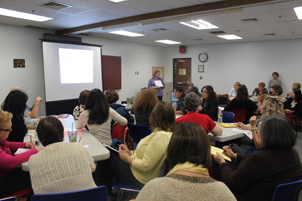
ELL Teachers gather to learn from each other
On Tuesday, October 18, 2011, the Bergen-Passaic NJTESOL/NJBE Chapter met at the Paramus Public Library in Paramus, NJ for its first meeting of the year. The well-attended event entitled “Off to a Good Start” was very successful and offered ELL teachers the opportunity to ask important questions related to the job of the ELL Specialist. The meeting sparked much discussion and highlighted common concerns shared by ELL teachers. Discussions included ACCESS tests, the soon to be published 2012 WIDA ELD Standards, legalities such as the three-year plans, and best practices using the CAN DO descriptors to inform mainstream teachers. Attendees were encouraged to visit WIDA’s website to review the ELD Standards as per 2012 and provide feedback by the deadline of November 11.
Note of Time Change: All future Bergen-Passaic NJTESOL/NJBE Chapter Meetings will be held at the new time of 4:30 pm at the Paramus Public Library.
Janice Silvia Acosta is the current Public Relations person for the Bergen-Passaic Chapter of NJTESOL/NJBE.
Chapter News
Bergen Passaic Chapter:
We Have the ACCESS Scores — Now What?
By Janice Silvia Acosta
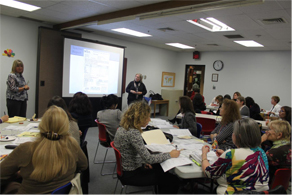
Barbara Tedesco and B.J. Franks Presenting
As ELL teachers, we are all familiar with WIDA’s ACCESS test to determine ELL students’ English language proficiency given each spring. But how many actually use the test scores to drive instruction? What do all those numbers mean anyway?
The Bergen-Passaic Chapter of NJTESOL/NJBE met at the Paramus Library in Paramus, NJ on November 15, 2011 for an informative session, “We Have the ACCESS scores – Now What?” The presentation was given by Barbara Tedesco and B.J. Franks, both WIDA-certified trainers [and past NJTESOL/NJBE presidents]. The session started with the attendees debriefing about questions given by the moderators. What is the purpose of the report? What does the data tell you? How can you use the data? Which scores might best inform instruction? Which help in designing support services? The presenters then guided the group through each question.
WIDA has made changes to some of the terminology used in the assessment. First, linguistic complexity will now read linguistic discourse. Language form becomes Language Forms and Convention, and ELP will be replaced with ELD. It is important that ELL teachers check out the Interpretive Guide on WIDA’s website as the rubrics scaffold across levels of language proficiency and these can be used in classroom instruction all year long. Translations are available by WIDA for the parent reports. When interpreting the ACCESS scores, one must realize that the scale scores for the domains cannot be compared. Rather, each domain stands on its own. When placing orders for the ACCESS tests for your students, it can sometimes be confusing as to which tier is best to order. The presenters recommended to always order up to be safe. ACCESS scores should be shared with classroom teachers in order to promote a more team-based approach for the ELL student. The ELL teacher can explain the results and guide the classroom teacher in the domains the student needs more support. It is important to view the results by academic subject as well.
With regard to exiting students, ACCESS scores should not be the only indicator of a student’s readiness to mainstream. Not all states accept multiple criteria for exiting, and New Jersey is one of the states that do recommend multiple measures besides the ACCESS scores. These can include ELL and classroom teacher assessments, other state-approved assessments such as the MAC II, writing portfolios, etc. Only with this multiple approach can a student’s true capability to function in the mainstream classroom be determined. It is recommended to advocate that ACCESS be used for ELLs vs. NJ ASK. ELL teachers are well aware of the struggles for ELL students taking NJ ASK, especially beginners. Recent research is showing that students are not getting higher scores on standardized tests until they are at an English language proficiency level of 5 [on the ACCESS].
No matter the proficiency level, the ACCESS scores can guide an ELL teacher in designing or redesigning support services. Students exiting an ELL program with a proficiency of 5 or 6 need to be monitored for two years to ensure they are transitioning well. ELL teachers should regularly inquire about their performances with the classroom teachers. Students with Mid-Level scores (Levels 3-4) may need one to three more years of ELL support. ELL teachers should consider a balanced long-term approach focusing on academic standards and English standards. They should utilize strategies that increase comprehension and communication in English (e.g. sheltered instruction). Teachers should look to enhance both oral and literacy development and provide L1 instruction and/or support as is feasible. Students with Beginner scores (Level 1 and 2) may need five or six more years of ELL support services. Here, it is important to provide targeted communicative/social and instructional English, scaffolded within programs and schools, and use content-based strategies and L1 instruction.
Attendees commented on how informative and useful they found this presentation. Ms Tedesco and Ms Franks were extremely helpful in advising how best to interpret the ACCESS results and how to use the data to drive instruction. Their expertise in this area made the meeting a huge success.
Janice Silvia Acosta is the current Public Relations person for the Bergen-Passaic Chapter of NJTESOL/NJBE.
Original 2012 Winter Header
2012 Winter SIGs / 2012 About
2012 Spring Features / SIGs
2012 Summer Features / SIGs
2012 Fall Features / SIGs
Voices Home Page
NJTESOL/NJBE Home Page