NJ Teachers of English to Speakers of Other Languages/
NJ Bilingual Educators
ARTICLES: WINTER 2024
Making Culturally Responsive Teaching Work– Zaretta Hammond
and
Looking Beyond the ‘Typical’ English Learner: the Intersectionality of Black English Learners in U.S. Public Schools– Leslie Villegas and Efren Velazco
Member of the Month – Nicole Awrachow
and
Barbara Tedesco Award for Two Collaborating Teachers
NJTESOL/NJBE Scholarships and Awards for Your Students and You!
and
Essay by an 8th Grade Award Winner– Valentina Ardila Valens
Why Being Bilingual Can Open Doors for Children with Developmental Disabilities, Not Close Them -Rebecca Ward and Eirini Sanoudaki, The Conversation
and
Advantages of a Bilingual Brain– Tracy Trautner
Return to Bilingual Education– Ester de Jong
Congratulations to February’s NJTESOL/NJBE Member of the Month- Kelly McLaughlin!
and
2 Billion People Celebrate Lunar New Year. Your Class Can, Too
2023 Raquel Sinai Newcomer Scholarship Award Winning Essay – Sarah Silva
and
Here’s what it was like for me to transition from ESL to mainstream classes– Karen Otavalo
Tracking AI in Education– Laura Ascione
2023 Higher Education Award Winning Essay– Yun Zhang
and
4 Steps to Becoming a Culturally Sustaining Teacher– Naashia Mohamed
Congratulations to March’s NJTESOL/NJBE Member of the Month: Monica DelRosario
and
Languages are both acquired and learned, so conscious and unconscious effort is needed when picking up a new one.– By Boris Vazquez-Calvo, The Conversation
Seal of Biliteracy Award Winning Essay– Weronika Pariaszewska
and
The NJ Seal of Biliteracy
January 2, 2024
Making Culturally Responsive Teaching Work
From Larry Ferlazzo, By Zaretta Hammond
 In this interview with Larry Ferlazzo, Zaretta Hammond observes that when educators, schools, and publishers try to implement culturally responsive principles in teaching, there are three misconceptions that can create pitfalls which could negate the effort.
“Misconception #1: Culturally responsive education is synonymous with implicit bias/anti-racism work. Therefore, if we work to eliminate our personal implicit biases in the classroom, it will foster a sense of connection for students of color that will increase their motivation to learn.” That is, teachers feel that they are culturally responsive only when they examine themselves for their own biases and when they are having discussions about racism with their students. Instead, there must be an atmosphere in the classroom in which students do not feel stereotyped and can be free to be vulnerable as they learn.
“Misconception #2: Culturally responsive teaching is all about relationship building and ‘honoring students’ cultural identities.” The basis for this is thinking that if teachers build connections with their students of color, the students will be more motivated to study. The problem is that this misconception is that it views the relationship as the end goal and ignores cultural differences in students’ learning styles. Hammond recommends a learning situation that is more demanding through supports that are like an apprenticeship that avoids too much scaffolding.
“Misconception #3: Culturally responsive instruction, in particular, is only about social justice and teaching students to recognize and critique social inequities.” The thinking is that there should be more diverse materials in the curriculum that they should emphasize social justice. However, this idea can exacerbate the problem of making black and brown children feel that they have to adjust to the classroom culture. A better approach is to find out what topics students are interested in that will create excitement in learning.
You can find the details and links to more resources here.
Looking Beyond the ‘Typical’ English Learner: the Intersectionality of Black English Learners in U.S. Public Schools
By Leslie Villegas and Efren Velazco
 Villegas and Velazco state that educators must understand Black ELs backgrounds in order to focus “on the challenges these students face today, how they are being supported in the K-12 system, and the important role families and community members can play in ensuring they are being served equitably.”
The demographics of Black ELs are shown through graphs, charts and statistics. The numbers of these students have quadrupled from 1980 to 2013. Surprisingly, the states where these immigrants have settled are not the same as those with the highest number of ELs.
Many of these students face racism, discrimination, and xenophobia in school and lower expectations which can undermine their potential and their educational aspirations. They may even be denied language learning support, and bilingual programs may not include their languages.
As a solution, the authors propose that, “We reconsider assumptions about what a ‘typical EL’ looks like and start tapping into the assets of communities of color to inform teaching practices and learning. Moving forward we must continue to examine the education systems and structures that perpetuate racial inequality by recognizing when injustices are happening in the first place. Only then will we begin to make progress towards linguistic equity among English learners.”
January 9, 2024
Member of the Month – Nicole Awrachow
Congratulations to January’s NJTESOL/NJBE Member of the Month – Nicole Awrachow!
 Nicole works strenuously to create and maintain the outstanding program her district of Maple Shade has today. She supports her peers by educating them on ways to assist MLs, as well as through workshops and weekly newsletters. The ESL Parent “Get Togethers” she coordinates include back to school night events, Library Nights, and an end of year get together for the families of her MLs. In addition, she has created a district ESL website and brochure to support the families of her MLs. Nicole has also developed support for the MLs in the district preschool classrooms since they are not receiving ESL at this time.
Nicole shared with us “It’s an honor to be chosen as the NJTESOL/NJBE member of the month, a community I have been lucky to be a part of for the past 18 years! ”
We are also excited to share that Nicole will be a presenter at the NJTESOL/NJBE Spring Conference this May!
Nominate the member of the month! NJTESOL/NJBE has so many amazing teachers throughout our state that it would be fitting to highlight some of them. Nominees could be colleagues who are available to answer questions about ELLs or the Bilingual Education code; educators who support students and their families beyond the classroom with projects, college applications, and extracurricular activities; someone who joins committees in support of ELLS or to implement positive change for the community. The nominee must be a member of NJTESOL/NJBE.
Barbara Tedesco Award for Two Collaborating Teachers
NJTESOL/NJBE is pleased to announce a new award, to be given for the first time this year. The Barbara Tedesco award will be given to an ESL/Bilingual educator and another educator (not an ESL/Bilingual educator) with whom they have a collaborative partnership in the same district. The winners will each be given a one day free registration to the NJTESOL/NJBE Conference for either the year of the award, or the following year’s conference.
 Barbara Tedesco is an individual whose work has advanced the state of teaching and learning in New Jersey by serving as a catalyst for the achievement of others. She is a founding mother and Past President of NJTESOL/NJBE, and our most recent historian, who has delivered professional development to 110 districts, in addition to college workshops, in the state of New Jersey through the company, LLAMAME, which she founded in 2009 with her long time collaborator, Dr. Elizabeth Franks. This award was created in order to to recognize the role that Barbara has played as a mentor to many of us in NJTESOL/NJBE and in the spirit of collaboration and celebration of the many years of service to the organization.
Please note: The application deadline is February 15th in order to offer the award in time to allow the winners to attend one day of the 2024 Spring Conference, May 29-31.
You can click here for more information and the application.
Applications for all of the 2024 awards and scholarships are now open for you and your students!
January 16, 2024
NJTESOL/NJBE Scholarships and Awards for Your Students and You!
 Encourage your students to apply now!
- Two Fourth Grade English Writing Challenges – two English learners who have been in the U.S. 3 years or less – Award: an iPad
- Two Eighth Grade English Writing Challenges – two English learners who have been in the U.S. 3 years or less – Award: a touch screen laptop
- Two $2,000 Raquel Sinai Newcomer Scholarships – two student in ESL and/or bilingual classes in grade 12 who have been in the U.S. two years or less
- Two $2,000 Pedro J. Rodriguez scholarships – ESL/bilingual high school seniors who plan to study in a New Jersey college
- Two $2,000 Seal of Biliteracy Scholarships – Two high school seniors who are current or former ESL/bilingual students who received the NJ Seal of Biliteracy in 2023 or will receive it in 2024.
- Praxedes León Parent Awards for $500 are given to the parents of the Seal of Biliteracy Scholarship winners
- Two $2,000 Higher Education Scholarships – Two ESL/bilingual students enrolled part-time or full-time in a NJ college – presently taking ESL courses
- $2,500 Dr. Jessie Reppy Memorial Scholarship – for a graduate student enrolled in an accredited master’s degree program with a major or specialization in teaching English to speakers of other languages
- $2,500 Bilingual Educator Scholarship – for a graduate student enrolled in an accredited program with a major or specialization in bilingual/bicultural education
(Application deadline – March 15th)
For Teachers!
- $1000 grant from Judie Haynes – for an educator who teaches English learners under difficult conditions. The grant money may be used to purchase materials or provide services. (Application deadline – March 15th)
- Barbara Tedesco Award – for an ESL/Bilingual educator and another educator (not an ESL/Bilingual educator) with whom they have a collaborative partnership in the same district. Each will receive a one day free registration to the NJTESOL/NJBE Conference for either the year of the award or the following year’s conference. (Application deadline – Feb. 15th)
Here are the Criteria and Applications
Essay by an 8th Grade Award Winner
By Valentina Ardila Valens
 “No sir, the problem is not immigration, it is EDUCATION! Being different doesn’t mean being inferior.” – Domingo Moreno-
When someone asks “What are the immigrants?” they will tell “People who come from a different country. ” “People who want a better future.” “People who want to leave us without work.” They said that so easily and with a tone of disgust or hate as if being an immigrant was the worse thing. Immigration is not just leaving your country and traveling to another. It is a big step to take. When you become an immigrant you are a person who leaves all your whole life in a different spot, and you change all your viewpoint of life, you change your thinking, you change everything of you. You are never the same person again. And if you are an immigrant who comes without papers, even if you are a teenager or not, it would be always hard for you. It doesn’t matter if they try to not do it, in the end, people judge or talk about you just because you don’t have papers.
People always said “you don’t have to treat them differently” or “they are humans like us” but they are the ones who treat immigrants differently. It doesn’t matter if it’s just by a look or a sign, and this happens a lot in schools. Sometimes people do this without intention but immigrants understand that and it makes us feel as if we were not part of that place. We want to feel like when we were in our country, simply fit in with a group of friends where you don’t feel judged for anything or even feel comfortable when you arrive at school, knowing that if you don’t know the language they have things that can help you to understand what’s going on.
An idea to try to make immigrant students feel comfortable in school could be putting signs on the walls of the hallways in other languages like saying the name of the “main office” “nurse” and “auditorium”, boards announcing events and describing them, for example, the traditional Big Nick, the winter dance, or the plays. Another idea would be talking in classes about the challenges that an immigrant face, and the different reasons for an immigrant to come to the country. They would talk and watch videos about different modern cultures, and do projects of different cultures. Finally, the school could do a culture day where in a different class the students can talk about their culture, what traditions they have, how they treat other people and the things that students can learn and adapt when they are talking with a person of a different culture.
In conclusion, making immigrants feels welcomed at school would be changing their mindset and showing them that there’s no just their culture but also my culture and everybody’s culture.
January 23, 2024
Why Being Bilingual Can Open Doors for Children with Developmental Disabilities, Not Close Them
By Rebecca Ward and Eirini Sanoudaki, The Conversation
 Ward and Sanoudaki begin their article with the concern that families of children with Down syndrome have regarding their child’s language development if they are exposed to a second language since the development of their first language is already delayed.
While this may seem logical, the authors examined a study in Wales which indicated that “bilingualism may have a positive impact on these children’s social interactions and the formation of their identity.” In fact, the research confirms that bilingualism does not increase confusion or language issues for children who experience language delays because of developmental disabilities. In Wales, the development of skills in English of children who had Down syndrome was the same for bilingual children as it was for those who were only exposed to English. The authors found research suggesting that the benefits of bilingualism may also extend to children with autism.
You can read the article and find links to the research here.
Advantages of a Bilingual Brain
By Tracy Trautner

Trautner explains how infants can notice different languages when they are six months old, can learn a second language at the same time as they learn to walk, and it does not interfere with their primary language. In fact, in their first eight years, children can learn languages easily.
When children switch their focus from one language to another, their brain becomes more flexible, and studies have shown that they are better at switching their attention, memory, and solving multi-faceted problems. Of course, studies have shown that adults can also benefit from learning a second language, so it is never too late.
Trautner’s question then, is why not teach young children a second language?
You can read the article here and find links to other information on the topic.
Return to Bilingual Education
By Ester de Jong
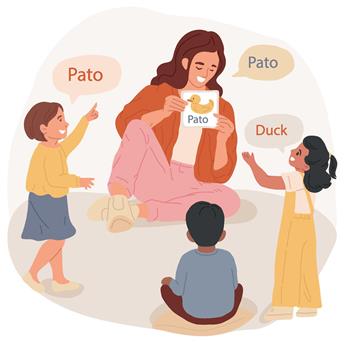 “In this excerpt from Foundations for Multilingualism in Education: from Principles to Practice (Caslon, 2011), Ester de Jong shares an overview of the history of language policy in the United States. ‘Return to Bilingual Education’ explores the 20th-century language policies that emerged after World War II, early bilingual education programs, and the Bilingual Education Act of 1968.”
Because of legal restrictions on immigration that began in WWII, and the resulting decrease in newcomers to the country, anxiety regarding their assimilation fell, and policies in education began to change towards pluralism. This was furthered by the Brown v. Board of Education Supreme Court case in 1954. WWII also brought the realization of the need for the study of foreign languages.
In the 1960’s, a school in Miami experimented in Bilingual education as enrichment for both native English speakers and Cuban immigrants. However, when this expanded to other locations, the goal was assimilation.
The Bilingual Education Act was passed in 1968 to mitigate the poor performance of non-English speaking children in schools. However, its purpose was remediation. This changed in 1974 when the BEA was reauthorized and defined bilingual education as teaching students in their native languages so they could progress in their schooling. Education policies are controlled by the states, so “if states or districts want the money, they have to meet the federal requirements. Under the BEA, districts had to implement bilingual education programs for the specified target groups in order to receive federal funding. It thus provided an incentive for districts to consider bilingual instruction options.”
The 1974 and 1978 reauthorizations provided bilingual education only for students who did not speak English. In 1984 and 1988 bilingual education was considered a failure, so additions to the BEA allocated funding for non-bilingual programs with the goal of mainstreaming MLs as quickly as possible. The reauthorization in 1994 “funded bilingual programs aimed at language maintenance and development and focused on content as well as language and literacy development.”
In 2001, the BEA was replaced by No Child Left Behind with the goal of successfully mainstreaming “limited English proficiency students”. Students’ home languages are only supported through Title VII of the BEA.
See the article for a list of changes in the BEA and a second list of related federal laws.
In related information, you can also read about the failure of English-Only Education Laws in various states and the repealing of those laws as well as states that have made English their official language. Also included are states with Bilingual Mandates, Multilingualism/Bilingualism Initiatives, Bilingualism Value Statements, Dual Language Initiatives, and the Seal of Biliteracy. You can find this on New America’s website.
On a related link, New America posted that In February, 2023, “the Biden Administration released its proposed budget for fiscal year 2024 which included $1.2 billion to support the education of English learners/multilingual learners (ELs/MLLs) through Title III.” As a result of this, some states have proposed additional beneficial legislation.
February 6, 2024
Congratulations to February’s
NJTESOL/NJBE Member of the Month
Kelly McLaughlin!
 Kelly is in her second year teaching at Morristown High School, but has already found ways to support the needs of all learners by creating engaging lessons that challenge students to achieve more. She often creates her own units on various topics. Her sense of humor and passion for teaching and learning are contagious.
As Kelly states in her own words, “I’m honored to be the NJTESOL/NJBE member of the month! I have had such a wonderful start to my career as an ELL teacher thanks to the support and guidance of all the educators in our community. I want to especially thank my cooperating teacher, Ms. Lidia Bis of the Newark Public Schools, and my colleagues and mentors, Ms. Kathryn Tepedino and Mrs. Alina White of the Morris School District.”
Please join us in celebrating one of our newest and inspiring members!
Nominate the member of the month!
Do you know a member of NJTESOL/NJBE who should be recognized?
NJTESOL/NJBE has so many amazing teachers throughout our state that it would be fitting to highlight some of them. Nominees could be colleagues who are available to answer questions about ELLs or the Bilingual Education code; educators who support students and their families beyond the classroom with projects, college applications, and extracurricular activities; someone who joins committees in support of ELLS or to implement positive change for the community. You can also self-nominate! The nominee must be a member of NJTESOL/NJBE.
2 Billion People Celebrate Lunar New Year.
Your Class Can, Too
By Sarah Elia
 Sarah Elia from New York TESOL wrote an article for Education Week about how you can celebrate the lunar new year with your students.
To give the celebration “a human touch” she suggests inviting a guest who is from China, Korea, or another Asian country to explain how they celebrate the lunar New Year, which is somewhat different in each country. The guest could be a parent, a college student, or someone from a Chinese or Korean American club.
Among her other suggestions are playing traditional music, sharing information about food, wearing red, and awarding prizes for solving riddles.
Sarah Elia is the Past President of New York State TESOL and an English as a New Language Teacher in Saugerties Senior High School, NY.
See her article for more ideas.
Additional options can be found in a blog by Paula Rock, Three ways to celebrate Chinese New Year with students and colleagues. Students can watch a brief video of the Legend of Nian, which explains the reason for wearing red. They can learn about the animals in the Chinese Zodiac or practice New Year greetings.
More ideas are presented by Onalee Smith in 10 Chinese New Year Classroom Activities: Throw a Lunar New Year Party. Some of these are cleaning in preparation for the holiday, eating mandarin oranges, and discussing the differences in the New Year celebrations across Asia.
You might also check the ProTeacher Community site for a longer list of activities.
February 13, 2024
2023 Raquel Sinai Newcomer Scholarship Award Winning Essay
By Sarah Silva
 The first advice that I would give to new student from another country would be is face it the better way possible, you will got it and you have been through worst, do not act like me, do not think that you will never feel on you place and sometimes is good to get out of our comfort zone. The other advice is for the exact purpose of learning to take time and try to immerse yourself in the culture. Also be prepared for discrimination, try your best to get good grade and join clubs at your school or university, it will help a lot and if you are struggling with the language, look for extra classes that could help you and join on conversation sites and do not be afraid of native English speakers, they will understand and will get that you are bilingual or speak multiple languages.
The ESL teachers will help you a lot, they are so kind and always try to put you in a good mood. New foreign students, do not be afraid of public speaking as I was or to do a presentation, I know that this scares us a lot, but we are bigger than our fears, and after you pass through the process never act mean or make a new student feel down by your attitudes. Third advice is always have a goal and a budget in mind, this will make your life easier because you know what you are looking forward to, this actually demonstrates that you are applied and a person who plans the future and knows what you want to be and want to do. To sum up everything that has been stated, do not change yourself and be kind to everyone, you will get it and look back and see that you made it.
Here’s what it was like for me to transition from ESL to mainstream classes
By Karen Otavalo
 Karen Otavalo, now a high school student, describes her debilitating fear of speaking up in mainstream classes in sixth grade when she was learning English. She was comfortable in her ESL classes, but suffered extreme anxiety in group discussions and even in conversations outside of those classes. This anxiety affected not only her academics, but also her mental well-being. She socialized only with her fellow MLs.
She expressed her feelings in this way.
During those initial months of transition, words eluded me. When they did surface, that all-too-familiar fear rippled through me. Speech used to be one of the things I was strongest at, and seeing myself fail at something so essential — not only to get my ideas across but also to be taken seriously — was disheartening. It didn’t help that despite hours of practice sometimes it seemed like I wasn’t getting better.
Eventually, with support from her teachers, she was able to speak in class even though she felt afraid. She found that she had to be patient with herself in her progress in learning English. To others in her situation, she recommends that speaking in class in spite of fear will make it easier the next time.
Here is the full story with links to studies that support her experience.
February 20, 2024
Tracking AI in Education
By Laura Ascione
 “It seems as if we hear about AI in education every day, if not every hour. AI’s rise in popularity has brought with it questions about ethics, skills students will need for workplace success, and how to balance negatives with positives when it comes to teaching with this new generative tool” (Ascione, 2024).
Here you will find answers to five questions about AI use for education. Each of these are linked to other articles that further address each question.
- What is the best AI tool for teachers? Five are listed which can make preparing materials much faster, give feedback for professional development, and provide recommendations that are tied to students’ progress.
- How is AI beneficial in education? Students can use it to cheat, but it can also be used to learn.
- What are the negative effects of AI in education? Since ChatGPT was launched, the concern, especially for those teaching writing skills, is that students won’t bother learning.
- What is the role of AI in education? The answer is that educators must raise the expectations of students’ performance and use AI for immediate feedback and for helping students improve their work.
- How can AI be used in teaching? For this, the assignment is to prove what AI can and cannot do.
You can find more information here.
See below for excerpts from the links in the article.
AI in Education, cont.

Q: What is the best AI tool for teachers? One of the tools linked is Eduaide.ai for creating lessons and materials. There is a free version or one with more options that costs $5.99 per month. The FAQ’s state that it is “accessible in 17 languages”, and it can generate lesson plans, charts, outlines, exercises, resources for collaborative learning, gaming, and assessments.
Q: How is AI beneficial in education?
MacKenzie Price lists “5 Positive ways students can use AI”
- 24/7 tutors – for step by step instructions
- Lessons come to life! – Students can have conversations with famous people in history.
- Custom study plans – with examples that use visuals
- Enhanced creativity – drawing whatever students can imagine
- Real-time progress tracking – for immediate feedback
Q: What is the role of AI in education?
In the article, “How AI could save–or sink–creative writing in schools”, Thomas Arnett writes,
“Now, more than ever, students’ future success in an ever-changing world requires that they learn how to think critically and creatively while collaborating with others to solve complex problems. But the unwritten curriculum of most schools—instilling process perfectionism through rewarding flawless performance—is probably doing more harm than good.”
The author proposes a dramatic change that the thinking that precedes writing is the most important step, and after that, AI can provide immediate “feedback on not only grammatical errors but also argument coherence, evidence use, and rhetorical strategy.”
February 27, 2024
2023 Higher Education
Award Winning Essay
By Yun Zhang
 Respecting the old and caring for the young is our traditional culture in China. To give an example, when an old man (Chinese people over 60 years old can be called an old man) is on the bus or subway, even if he looks very healthy and sees an old man, However, young people, both male and female, will take the initiative to stand up and give him a seat. This behavior we call respect, however, an American friend of mine was not happy with this behavior. When he was traveling in China, a young lady stood up and offered him a seat on the subway when he was traveling in China. Of course, he also refused the lady. polite behavior.
In China, most parents always criticize their children in front of friends or relatives but praise other people’s children. They themselves think this is a kind of modest behavior. However, in the US, what I see is that parents often praise how good their children are in front of their friends. In China, people can insult people you don’t like in any public place or social media, even any racial discrimination, but remember, the only thing you can’t treat is the highest national leader, if you do, what awaits you is going to jail, or even It may involve your life safety.
When I first came to the United States, I was extremely shocked. People can insult the president at will, but they are very careful to use any language and behavior towards ordinary people. I want to say without reservation that I respect the culture of every country, but I love American culture more, and this is how I feel after living here for many years, this culture is harmonious, and this culture gives people a sense of self-confidence And courage, this is why I study English very hard, I want to integrate into this country more deeply, I love America, I love this harmonious, free and mutual respect environment.
4 Steps to Becoming a Culturally Sustaining Teacher
By Naashia Mohamed
 Naashia Mohamed begins this blog by establishing the need for a “Culturally Sustaining Approach” in teaching.
“When a child experiences a disconnect between the language and culture of the home environment and that of their school, they may feel alienated and consequently disengage from learning.”
She recommends these four steps to implement this approach.
- Reflect on Our Own Cultural Lens – We need to ask ourselves about our assumptions and views to reveal what may be our own unconscious biases. “Through regular critical reflection, we can develop cultural competence to understand, appreciate, and be sensitive toward the histories, values, experiences, and practices of others.”
- Get to Know and Involve Learners’ Families and Communities – Recommendations are meeting students individually, having them write about themselves, or arranging meetings with families so parents know how to help their children succeed.
- Incorporate Learners’ Funds of Knowledge – Students are more excited about learning when their traditions and cultures are included in what is being taught.
- Model High Expectations – Marginalized students may believe negative stereotypes about themselves. They need opportunities for success and feedback that is “specific, consistent, and individualized” to help them reach their potential.
The author acknowledges that “Making any kind of change is a slow and challenging process. But these four steps can help to make our classrooms spaces in which students of all cultures and backgrounds feel supported to learn and succeed. By embracing culturally sustaining approaches to teaching and ensuring that our classrooms are spaces of inclusivity where everyone feels safe, valued, and heard, we can help students to feel a sense of belonging in school.”
You can see the article for fuller explanations.
March 5, 2024
Congratulations to March’s NJTESOL/NJBE Member of the Month
Monica DelRosario

Monica is fairly new to teaching ESL, but has jumped in with both feet. She advocates and actively looks for the best ways to support her students, especially her SLIFE students. She lives and works in Roxbury district. She also has four beautiful children (with her husband of 20 years). She can often be found cheering on her students and children at football games or other activities.
Monica is currently finishing her ESL certification and pursuing her bilingual certification and Master’s in Urban Education.
Monica shares, “I have a heart for advocacy and a love of people and am humbled to be a part of such an amazing group of educators fighting for our multilingual families.”
Nominate the member of the month!
NJTESOL/NJBE has so many amazing teachers throughout our state that it would be fitting to highlight some of them. Nominees could be colleagues who are available to answer questions about ELLs or the Bilingual Education code; educators who support students and their families beyond the classroom with projects, college applications, and extracurricular activities; someone who joins committees in support of ELLS or to implement positive change for the community. The nominee must be a member of NJTESOL/NJBE.
Languages are both acquired and learned, so conscious and unconscious effort is needed when picking up a new one.
By Boris Vazquez-Calvo, The Conversation
 Vazquez-Calvo describes two processes of learning a language. Awareness of both provides guidelines for educators of adult and teen MLs.
Acquiring a language through exposure, which is the predominant way children learn, “does not require conscious effort or formal instruction.” There is no need to pay attention to rules to use the language correctly.
Adults, on the other hand, mostly learn through explanations of the structure and use of the language and through studying, which requires deliberate conscious effort. The benefit of this is the ability to understand and begin to use complicated grammar. By being aware of the rules, the learners can self-correct as they develop fluency.
For the best results when trying to learn a new language, Vazquez-Calvo recommends combining both methods.
March 12, 2024
Seal of Biliteracy Award Winning Essay
By Weronika Pariaszewska
 The first word that comes to my mind is “understanding”. The Seal of Biliteracy allows others to understand what our education looked like. You see, I believe that people tend to judge wisdom on a very shallow level. But without truly taking in the whole picture of one’s journey, we can never measure their potential and their strengths. That’s probably the first and most important reason. The Seal of Biliteracy lets others see you for who you really are!
Secondly, it actually greatly helps people. This achievement lets people know what you are really capable of, thus judging that your education differs from those who only learned it in one language.
The Seal of Biliteracy aids you in your life, but it can also be extremely helpful with helping others. Being fluent in two or more languages lets us help others, and encourages them to speak for themselves, as well as be understood in the world. This, I think, is one of the greatest aspects of being bilingual, the ability to share others’ voices.
There are many other benefits to this honorable achievement that I haven’t mentioned. Those pros include your job opportunities, as well as recognition among coworkers, peers, and fellow classmates. Yet these benefits must also come from your determination to allow yourself to stand out, which is not the easiest thing to do many times. We often get scared of judgement or unwanted comments from people who aren’t educated enough about our circumstances. Yet that is precisely why it is so important for as many people as possible to do the Seal of Biliteracy. We need to acknowledge that people like us are what makes this country so incredibly unique and diverse.
The NJ Seal of Biliteracy
 “The New Jersey State Seal of Biliteracy is an award given by the New Jersey Department of Education (NJDOE) in recognition of students who have studied and attained proficiency in at least one language in addition to English by high school graduation. The NJDOE … established the State Seal of Biliteracy program in 2016 to help students recognize the value and the tangible benefits of bilingualism.”
Elizabeth Franks, an NJTESOL/NJBE Past President, who served our organization in many capacities, along with a small cadre of dedicated supervisors and districts, was instrumental in establishing the award, securing state approval, and transitioning the management of the Seal to the New Jersey Department of Education. To date, 39,008 students in New Jersey have received the Seal of Biliteracy since its inception.
You can find information and requirements for obtaining the seal of biliteracy on the NJ state education website.
Announcements from Winter 2024
Share your successes with other members by writing an article for the annual Voices Journal!
Topics include:
- Current issues
- Classroom explorations
- Program descriptions/exemplary scheduling
- Alternative perspectives
Here are the guidelines. You can read previous issues here.
Submissions are due January 15th for publication in early March. (Extended to Jan. 31st.)
Somerset-Hunterdon County Chapter, Mark Your Calendar! Meeting #2: Wednesday, January 17 4:30-5:30 via Zoom: Looking and Learning about the 2020 WIDA Standards Framework with our guest speaker Maggie Churchill. We will send a Zoom link as the date approaches.
Parents of Multilingual Learners join us for Padres con Poder/Parent Power, Parents of Multilingual Learners join us for Padres con Poder/Parent Power, NJTESOL/NJBE’s FREE Virtual workshop on Saturday, January 20, from 9:30 – 12:30! There will be live presentations, recordings, and an online library of resources available. Topics will include student and family support with school issues, how to support students’ learning, Preschool information for families, and a presentation by Seal of Biliteracy graduates.
Join us for the NJTESOL/NJBE 2023-2024 PLC Series: Teaching Bilingual Students Bilingually. PLCs will meet on Zoom to build community among bilingual educators & discuss program types, language frameworks, lesson/unit development, and so much more!
Our second session is Saturday, January 27, 2024 from 10:00 – 11:30.
You are invited to join us for our third session of the NJTESOL/NJBE 2023-2024 PLC Series: Teaching Bilingual Students Bilingually Following an Assets-Based Approach to Biliteracy and Content Achievement, Saturday, March 9, 2024, at 10:00.
Bergen County Chapter – Meeting – January 31, 2024, 4:30-5:30 PM, Fair Lawn High School, Room D-203, 14-00 Berdan Avenue, Fair Lawn, NJ, Parking is available in the parking lot on Fairclough Place behind the high school.
Are you interested in new ideas for your classroom?
Come join us to share ideas, activities, and resources to be used in the classroom. If you have lessons and activities you would like to share, please feel free to bring them. Please invite your content area colleagues and administrators as well. Everyone is welcome.
Members are invited to join NJTESOL/NJBE’s Professional Committees. The Advocacy Committee is meeting on February 15 at 5:00 and the Countering Anti-Black Racism Committee is meeting on February 12 at 7:00. Please email executive-director@njtesol-njbe.org by February 8 for the Zoom link if you are interested in attending either committee meeting or both!
Civil Rights Webinar – Free Information Session for New Jersey Educators, Lawyers, Community-Based Organization Staff, and Parents or Guardians – Using Federal Anti-Discrimination Laws to Protect English Learners – Thursday, March 14th, 2024, 4:30 – 5:30 PM
We Invite You To Get Involved
If you would like to become a member of the Executive Board, you can nominate yourself. There are only two requirements: to be teaching in the field you are seeking to represent and to have been a member of NJTESOL/NJBE for at least one year. The term is two years with the option of running again to serve an additional two years for the same position. Each year, alternate positions are open.
This year the open positions are for:
Vice-President
Special Interest Group [S.I.G.] Representatives
Bilingual Elementary Education
Bilingual Secondary Education
Teacher Education
Adult Education
Supervisors
Nominations must be submitted by 10:00 PM March 15, 2024
Nominate the member of the month!
NJTESOL/NJBE has so many amazing teachers throughout our state that it would be fitting to highlight some of them. Nominees could be colleagues who are available to answer questions about ELLs or the Bilingual Education code; educators who support students and their families beyond the classroom with projects, college applications, and extracurricular activities; someone who joins committees in support of ELLS or to implement positive change for the community. The nominee must be a member of NJTESOL/NJBE.
Scholarships and Awards for you and your students – Start the applications now! There are 4th and 8th grade awards, high school, higher ed, and teacher ed scholarships, and the Judie Haynes grant for teachers – due date March 15th. The new Barbara Tedesco award for a bilingual or ESL teacher and collaborating educator is due Feb. 15th! Apply here.
All members of NJTESOL/NJBE are invited to attend our 2nd Countering Anti-Black Racism (CABR) Committee Meeting on Wednesday, March 20th from 7:00-8:30 pm. We will continue to engage in some collaborative learning and discussion specifically around language ideologies and “proper English” building on H. Samy Alim’s keynote address along with two additional podcasts.
2024 Spring Conference – Systems of Support for Multilingual Learners
You can attend in person at the Hyatt, New Brunswick May 29, 30, & 31
OR watch the Video Library Workshops June 3 – Sept. 2.
Beat the deadline by Registering Early!