Multilingual Learner Families: Learning and Empowerment Opportunities
By Dr. Nurka L. Nieves
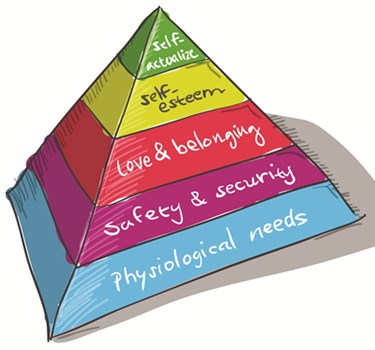 The five levels of Maslow’s Hierarchy are a theoretical model that highlights foundational human needs, ranging from physiological to self-actualization. From basic needs to psychological ones, including survival, security, connection and community, self-respect, and being and living in one’s full potential-fulfillment and growth.
Applying Maslow’s Theory to immigrant children and their families is a topic growing in the literature. As educators of multilingual learners, we can macroscopically and microscopically seek ways to provide learning opportunities to empower new families in our school communities. Macroscopically, welcoming multilingual learners and their families to the school district is imperative in the psychological levels of Maslow’s theory, beginning with connection and community:
- Being school district role models demonstrating cultural competencies and commitments to multilingual learner success.
- Providing holistic support through outreach to newcomers through community outlets, such as health organizations for insurance, non-profits, churches, and family support groups.
- Pointing to community learning centers, which provide adult ESL instruction and other instructional resources.
- Corresponding in various languages, providing online materials in the home language, having translators available, and using translation devices for communication purposes.
- Parent advocacy groups-Sharing information about federal accountability, protecting multilingual learners and their rights, and having their voices count.
- Conversations about intervention for all students, and if necessary, Special education.
- Having a trauma-informed lens guides families towards social-emotional supports.
- Connecting multilingual learner families to other families in the district.
- Holding ample opportunities to demonstrate how content is taught in the United States and how their children will be assessed through multilingual math and literacy nights.
- Showcasing multilingual learner families’ talents in and outside the classroom.
- Discussions about cultural norms.
Most importantly, creating a sense of belonging estableciendo confianza-establishing trust, the biggest factor for multilingual learner success, and an inclusive school environment for success.
In addition, fostering a family within families, by using the 7 C’s of Parental Engagement, evidence-based family engagement skills and concepts to enhance capacity building toward equitable relationships: communication, collaboration, compassion-caring, culture, connection, community, and collective responsibility, as the backdrop to fulfill this Maslow level.
Dr. Tammie Castillo Shiffer states it best: “Parents are the experts, and so when we ask them questions and we really put forth that effort, we’ve had fantastic results from just those conversations, and when we come through and we implement those recommendations, that really goes a long way in building trust, and parents and families know that we are really committed, that we’re going to do more than talk about it, we’re actually going to do the work.”
Microscopically, educators of multilingual learners add value to their students’ academic and linguistic proficiencies by allowing students to fully exercise their linguistic repertoire. Knowing the immense value of translanguaging offers multilingual learners open communication to present content mastery while learning a second language and demonstrating social skills.
Teachers of Multilingual Learners integrate learning opportunities and empower their students and families by applying lived experiences into classroom lessons. It is a weave of academic learning standards, English language development standards, showcasing a plethora of families’ funds of knowledge, with new content material understandable and familiar to multilingual learners.
Honoring family engagement is the perfect opportunity to share instructional information about multilingual learners’ strengths and weaknesses, supporting their achievements and holistic well-being. Collaborating with multilingual families cements the bond between the multilingual learner and the school community’s desire for their academic, linguistic, and socioemotional growth. These partnerships use Maslow’s theory as the framework for multilingual learner success.
Dr. Nurka L. Nieves is the NJTESOL/NJBE Family/Community Action SIG Representative.
References
Clark-Louque, A. R., Lindsey, R. B., Quezada, R. L., & Jew, C. L. (2019). Equity
Partnerships: A Culturally Proficient Guide to Family, School, and Community Engagement. SAGE Publications.
Family Engagement to Support Immigrant and Multilingual Families. (2023). United States Department of Education. Family Engagement Learning Series.
Figueras-Daniel, A., & Vasquez, B. (2024). Engaging Families of Multilingual Learners: Using Families’ Stories to Link Classroom Content with Children’s Funds of Knowledge. NAEYC. https://www.naeyc.org/resources/pubs/yc/fall2024/engaging-multilingual-learner-families
Supporting Multilingual Learners and Families. (n.d.). Retrieved January 21, 2025, from
https://www.rti.org/sites/default/files/documents/2024-04/Supporting%20Multilingual%20Learners%20and%20Families.pdf