• Home
  • Submission Guidelines
    • Journal Submission Guidelines
  • Annual Voices Journal 2026
    • What New Jersey Bilingual Educators need now: WIDA’s Marco DALE, the Spanish language development standards
    • Bridging Languages, Building Confidence: A Three-Year Journey with the Bridge Technique
    • Utilizing Home Languages to Support Reading Comprehension
    • Equity is a How, Not a What: Partnering with a Shared Vision for Multilingual Student Success
    • From Chalkboard Lines to AI Maps: Reimagining Sentence Diagramming for Today’s English Learners
    • Say More! With Nina and Ms. Lee
    • College Readiness – Bridging Pathways to Higher Education
  • 2026 Summer Weekly Voices
    • A Scaffolding Strategy to Help Experienced ELLs Express Complex Ideas
    • Free Resources to Support Students Affected by Forced Migration
    • Targeted Exercises That Develop Students’ Revision Skills
    • Keys to Making Videos Comprehensible to MLs
    • Why dual language programs may be one of our best school attendance levers
    • Getting Ready for College: What ELL Students Need to Know
    • 10 Activities to Improve Your English Grammar
    • Should You Really Use AI to Write That First Draft? (And What to Do Instead)
    • Teachers Of Intermediate & Advanced ELLs Should Consider Radically Redesigning Their Classes
    • 10 things for teachers to know about English language learners
    • Get In-Formed: The Power of Forms to Get to Know Your Students
  • About Us

Contact Us by Email

webmaster@njtesol-njbe.org
njtesol-njbe-voicesnjtesol-njbe-voices
  • Home
  • Submission Guidelines
    • Journal Submission Guidelines
  • Annual Voices Journal 2026
    • What New Jersey Bilingual Educators need now: WIDA’s Marco DALE, the Spanish language development standards
    • Bridging Languages, Building Confidence: A Three-Year Journey with the Bridge Technique
    • Utilizing Home Languages to Support Reading Comprehension
    • Equity is a How, Not a What: Partnering with a Shared Vision for Multilingual Student Success
    • From Chalkboard Lines to AI Maps: Reimagining Sentence Diagramming for Today’s English Learners
    • Say More! With Nina and Ms. Lee
    • College Readiness – Bridging Pathways to Higher Education
  • 2026 Summer Weekly Voices
    • A Scaffolding Strategy to Help Experienced ELLs Express Complex Ideas
    • Free Resources to Support Students Affected by Forced Migration
    • Targeted Exercises That Develop Students’ Revision Skills
    • Keys to Making Videos Comprehensible to MLs
    • Why dual language programs may be one of our best school attendance levers
    • Getting Ready for College: What ELL Students Need to Know
    • 10 Activities to Improve Your English Grammar
    • Should You Really Use AI to Write That First Draft? (And What to Do Instead)
    • Teachers Of Intermediate & Advanced ELLs Should Consider Radically Redesigning Their Classes
    • 10 things for teachers to know about English language learners
    • Get In-Formed: The Power of Forms to Get to Know Your Students
  • About Us

All Learners are Language Learners: Planting the Seed of Language
Development in ALL Spaces

Cecilia Vila Chave
NJTESOL/NJBE President
NJ Supervisor of ESL Programs

One of the challenges (or opportunities!) of coaching educators to implement SLA strategies in their content area classrooms is their belief that we are adding to an already full plate. The most common argument as to why those strategies are not consistently in place are: “I have X number of students; I can’t be doing something different for everyone.” My strategy for combatting this challenge and shifting mindsets has been repeating the mantra: All Learners are Language Learners. However, in an era where educators are required to use data to support the choices they make in their classrooms, I too have to provide evidence that this mantra is also a fact.

As an administrator, I have come to realize that long-lasting change takes time and in order for the changes to stick, you have to leverage members of your team as models rather than speaking from your own experience. To that end, I partnered up with one of our high school social studies teachers this year to model how SLA strategies enhance student learning and achievement, regardless of the student:

  • Who? A veteran Social Studies teacher at a NJ high school, teaching a dual enrollment course on Holocaust and Modern Day Genocide. All students in this classroom were monolingual or former MLs.
  • Why? At the beginning of the school year, the teacher reflected on the lack of engagement in classroom discussions with her students: “In years past, students were leading conversations, generating opinions, and contributing to the learning. But this year, it is … crickets.”
  • What? We discussed that in order for students to meaningfully engage in conversation they need explicit language instruction: Speaking, Listening, Reading, and Writing. And that the Language for Social Studies needed to also be explicitly taught.
  • How? We worked together in developing a plan to embed two tried and true strategies for multilingual learners, with her dual enrollment students:

reflection journals📒Reflection Journals: students were given a journal (they got to decorate it and make it their own!) and the protocol for student reflection, organized thinking, and activating prior knowledge was set.
💬Community Circles: students were engaged in the practice of “classroom circles” sometimes leveraged as “restorative circles”, where everyone had the opportunity to share meaningfully and safely. The success of this strategy relied upon two key norms of engagement the teacher set forth: be present and listen to understand not to respond.
🧱Personal Word Walls: students were given the opportunity to explore the academic / target language for the unit before starting to learn the content. They worked over multiple days to write the vocabulary/ concepts, define them, apply them in context and practice the pronunciation of any non-English words.

example of a personal word wallThe outcome? Students were able to organize their thinking without fear of “being wrong”, they were able to engage in meaningful conversations about difficult topics, and they acquired learning skills that enhanced their understanding and were transferable to any topic or subject.
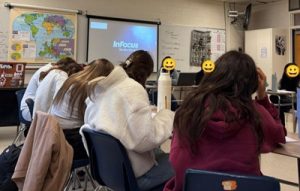
Community Circles

The biggest lesson I have learned from my four years as a Supervisor is to focus energy on identifying positive disruptors in a team and work hard at creating the spaces they need to try new things, without fear of failure, and let them be the ones to lead the change. This is an example of a transformational educator, who no matter how many years they have been in the field, they are committed to learning and growing as a teacher too. My many thanks to them for providing the data to support the mantra: All Learners are Language Learners.

Announcements

Dear Coaches – If you’d like to submit an advice inquiry to the ESL and Bilingual Coaches you may fill out the “Dear Coaches Anonymous Advice Form”.
You can view previous “Dear Coaches” responses here.

Panel Discussion: Building Resilience in the Classroom: Strategies Through the STAHR Framework, Tuesday, June 2, 2026 5:00-7:00 PM
Hosted by NJTESOL/NJBE
This session brings together diverse perspectives and professional expertise to support school communities in addressing immigration-related stress through trauma-informed practices. The focus extends beyond the “whole child” to also include the “whole educator.” Participants will be introduced to the STAHR Framework (Supportive, Trauma-Informed, Approaches, Humanizing, and Resilience), a structured approach designed to support multilingual learners and their families. Grounded in culturally responsive teaching and trauma-informed research, this framework integrates a Multi-Tiered System of Supports (MTSS) to provide practical strategies educators can use across all levels of support. The goal is to ensure student well-being and safety are prioritized throughout the school environment, while also recognizing resilience as a supported, ongoing process rather than a fixed trait.
Administrators, educators, parents, and community members are welcome.
Register on Eventbrite.

2026 Spring Conference Platinum Sponsor

Message from the President, Cecilia Vila (left)CeciliaJenna Maneri
and
Message from the Vice President, Jenna Maneri (right)

ARTICLES

Instruction as Advocacy– Amber Ingram

Building a Professional Learning Network (PLN) on Social Media: What Worked for Me!– Cecilia Vila Chave

Meet the 2026 Spring Conference Invited Speakers

10 Activities to Improve Your English Vocabulary -Emile Dodds
and
Uncovering Language Learning Strategies for University Students in STEM -Tokyo University of Science

Wordless but not silent: Unlocking the power of wordless picture books -Jennifer D. Honaker, Ryan T. Miller
and
Virtual art meets language learning: A tech-enhanced ESL experience
-Nesreen El-Baz, ESL Educator

The Courage to Learn -Douglas Fisher, Nancy Frey, and James Marshall
and
When Have You Ever Failed at Something? What Happened as a Result? -Katherine Schulten

Adapting Gradual Release of Responsibility for English Language Learners -Tan Huynh and Beth Skelton
and
Using PBL to Support Young English Learners -Cecilia Cabrera Martirena

Language of Identity, Language of Access -Michelle Benegas and Natalia Benjamin
and
Classroom Activities for Building Critical Multilingual Awareness -Naashia Mohamed

Using a True Crime Book as a Bridge Towards L2 Literacy -Elizabeth Farro

Cultivating Team Dynamics that Strengthen ML Instruction -Corinne Galasso

Message from the President
and
Message from the Vice President

All Learners are Language Learners: Planting the Seed of Language Development in ALL Spaces -Cecilia Vila Chave

ESL Summit at Bergen Community College -Leah Carmona

Schools Turn to AI Translation Tools to Support English Learners -Lauren Coffey
and
What AI earbuds can’t replace: The value of learning another language -Gabriel Guillen and Thor Sawin

NJTESOL/NJBE Voices Editorial Board

Executive Director
Kathleen Fernandez

President
Maria Cecilia Vila Chave, Township of Ocean School District

Past-President
Michelle Land, Randolph Township Schools

Layout
Dale Egan, Bergen Community College

Technology
Marilyn Pongracz, Retired from Bergen Community College

NJTESOL/NJBE Home Page

Visit the home page, NJTESOL/NJBE
for
Advocacy
Spring Conference Information
Chapter Meetings
Discussion List Information
Membership
Helpful Links

Affiliated With

NJTESOL/NJBE Voices